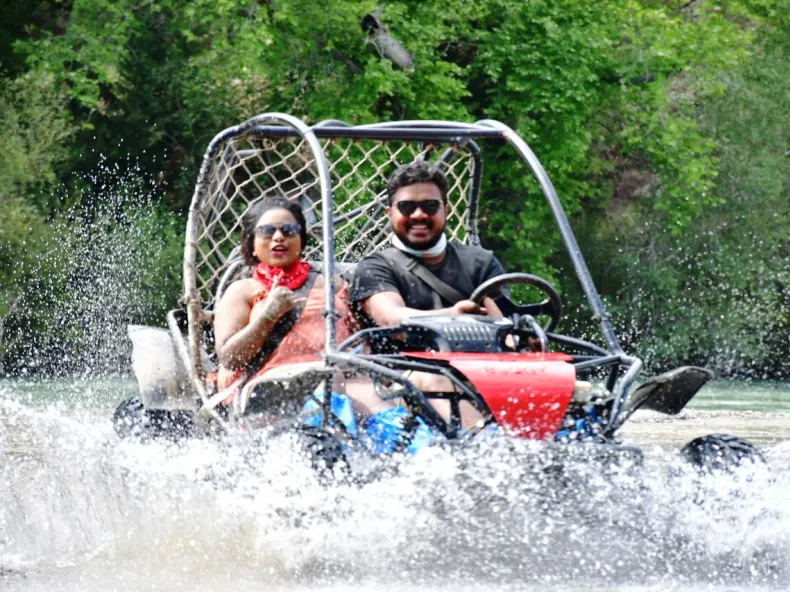
The short answer: most buggies are two-seaters
If you picture an off-road buggy safari, you are almost certainly picturing a two-seat buggy — a low, caged machine with two seats side by side, a roll cage over your heads and a seatbelt for each rider. This is by far the most common vehicle on a standard safari, and it is priced per buggy, so two people share one machine and one price. For couples, friends and families, that is genuinely great value.
A true single-seat buggy — one machine, one rider — does exist, but it is much less common on a typical group safari. If you specifically want to ride solo in your own vehicle, the honest advice is to ask about availability when you book rather than assuming it is on offer.
How driving turns work in a double buggy
The most common question is simple: if two of us share one buggy, who drives? The answer is up to you, and it is flexible.
- Take turns: most pairs swap at a safe point partway through, so each person gets a stint at the wheel and a stint enjoying the ride.
- One driver: if only one of you wants to drive — perfectly common — the other simply rides along as the passenger the whole way.
- Film the fun: the passenger seat is the best spot to record the dust, mud and grins for later.
Whichever way you split it, both of you are strapped in inside the same roll cage, so you share every bump, splash and laugh together.
Can a child ride as the passenger?
Yes — and this is one of the biggest advantages of a two-seater. Because the buggy has a roll cage and a seatbelt for the passenger, a child can ride safely buckled in beside a parent while the adult drives. Families get to stay together in one machine instead of splitting up across separate solo vehicles.
Being honest matters here: minimum ages and conditions do apply, and they are set for safety on the day depending on the child and the route. Please confirm your child's age and suitability when you book, so the team can advise you properly rather than promising something that might not fit on the day.
When does a single seat make sense?
A solo or single-seat setup can be the better call in a few specific situations:
- You are travelling alone and would rather have your own machine than be paired with a stranger.
- You want full control the entire time with no swapping and no passenger.
- You are a confident, experienced rider who simply prefers riding solo.
Even then, remember that a two-seat buggy driven solo still gives you the whole machine to yourself for the ride — you just have an empty passenger seat. So 'riding alone' does not always require a dedicated single-seat vehicle; often it just means booking a two-seater and driving it yourself.
Double vs single: quick verdict by traveller type
To make it easy, here is who each option tends to suit:
- Couples: a two-seater is ideal — share the ride, swap the wheel, one films while the other drives.
- Parent and child: a two-seater is the clear winner, keeping you together with the child safely buckled beside you.
- Groups of friends: two-seaters let you pair up and race each other on the trails.
- Solo confident rider: ask about a single seat, or simply take a two-seater out on your own.
Whether you end up in a single or a double, the core experience is the same on our safaris. Every ride starts with a full safety briefing and a practice lap, you wear a helmet, a guide leads the group pace, and the trails are real off-road forest and mud tracks rather than tarmac. Free hotel pick-up and drop-off is included, so you can focus on the driving and leave the logistics to us.
The bottom line
For most travellers, the two-seat buggy is the natural and best-value choice: you share one machine and one price, take turns driving, and can bring a child along as the buckled-in passenger. A single seat is worth asking about mainly if you are solo and want your own vehicle. Check the live details and 'from' price on the tour card shown here, and if in doubt about seating or your child's age, just ask when you book.